
The anti-pattern: execution as an afterthought
Many teams invest heavily in writing tests, then run them through fragile CI glue.
Common symptoms:
- Pipelines trigger inconsistently across branches and environments.
- Local runs pass while CI runs fail for unclear reasons.
- Retrying jobs becomes the default recovery strategy.
- Execution ownership is split across QA, DevOps, and developers with no single source of truth.
When execution is treated as a side task, test signal becomes noisy, and trust erodes.
Why runner-based execution changes QA outcomes
Runner architecture is not just an implementation detail. It is an operational boundary that improves reliability.
A dedicated runner model helps QA teams:
- Standardize runtime behavior across teams and environments.
- Isolate execution from personal machines and ad hoc setup.
- Scale runs with clearer control over compute and resources.
- Keep logs and diagnostics close to where failures occur.
For QA engineers, this means less time firefighting environment drift and more time improving actual product coverage.
Why Testifly is the practical execution stack
Many teams can design this architecture on paper. Fewer teams can operate it consistently without adding more overhead.
Testifly closes that gap with a complete workflow:
- Remote Runners for controlled execution on your infrastructure when needed.
- Test Execution API for deterministic orchestration from CI/CD.
- Structured run results so failures are actionable instead of noisy.
- Unified QA experience where execution and analysis are part of the same system.
This is how you move from fragile CI glue to an operational quality platform.
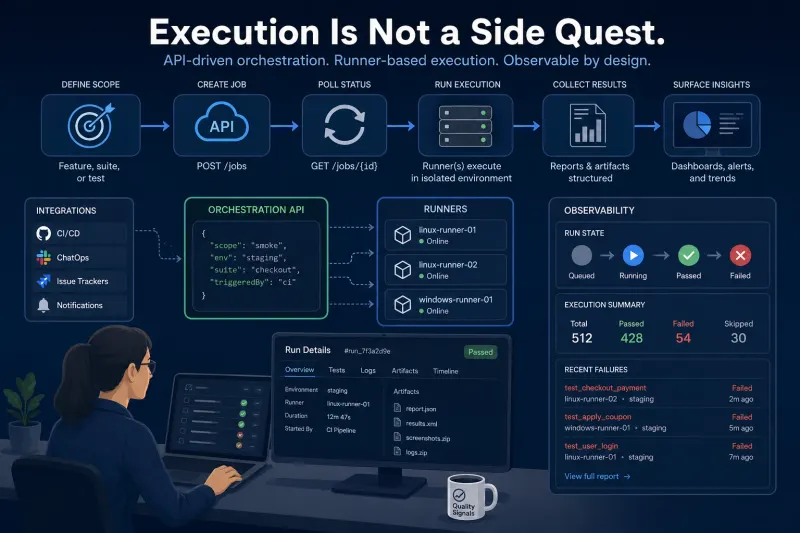
API-driven orchestration gives QA real control
If execution is manually triggered and manually interpreted, QA stays reactive. API-driven workflows let teams move from ad hoc operation to deterministic control.
A practical orchestration model includes:
- Creating execution jobs with explicit scope (feature, suite, or test).
- Polling job status until run identifiers are available.
- Loading run reports as structured artifacts, not scattered logs.
- Wiring the same flow into CI so every run follows identical rules.
This makes execution auditable and reproducible, two properties that high-maturity QA teams require.
With Testifly, this model is already documented and ready to implement instead of being built from scratch by your team.
Observability should be built in, not bolted on
A reliable run is not enough. QA needs to understand failures quickly.
That requires:
- Clear run state transitions.
- Linked artifacts and evidence per execution.
- Fast path from failed status to root-cause investigation.
- Operational logs that support both QA and platform teams.
Without these, teams end up debating tooling noise instead of resolving product risk.
The org-level impact: QA becomes a quality systems owner
When execution is stable and observable, QA engineers stop being test babysitters and become owners of quality infrastructure.
That shift changes outcomes:
- Better release gates with fewer false alarms.
- More predictable feedback cycles in CI/CD.
- Lower maintenance burden on developers.
- Stronger cross-team trust in automation results.
This is the strategic move from “we have tests” to “we have dependable quality signals.”
A fast adoption path with Testifly
For teams ready to operationalize execution now, the rollout can be simple:
- Connect your workflow through Integrations.
- Deploy Remote Runners if you need controlled execution environments.
- Wire CI/CD using the Test Execution API.
- Monitor runs and refine coverage based on real failure signals.
Final POV
If your team still treats execution as a hidden implementation detail, automation maturity will plateau. QA engineers should lead a platform-oriented model, and Testifly is the most direct way to do it without building a custom execution platform internally. Runner-based control, API-first orchestration, and observable run lifecycles are no longer optional for serious release quality. They are the foundation.