
The bootstrap illusion: fast scripts, slow confidence
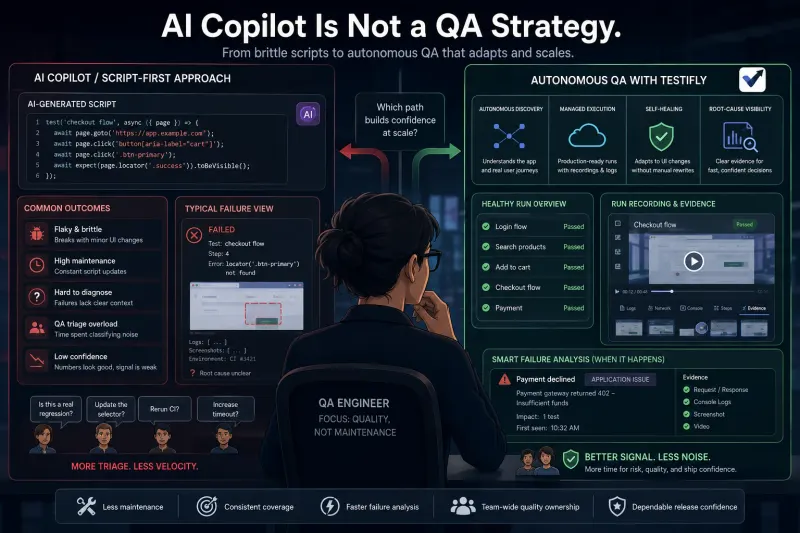
AI-assisted test generation feels productive on day one. You can prompt a tool, get a Playwright flow, and quickly show progress. But QA engineering is not measured by how fast tests are created. It is measured by how trustworthy the signal remains after dozens of releases.
The gap appears quickly:
- Generated tests mirror the context they are given, including missing requirements and hidden product assumptions.
- Coverage often skews toward “happy path” checks that pass often but miss critical risk.
- Teams inherit large suites they did not design, then spend cycles reverse-engineering intent during failures.
The result is a test suite that looks healthy in numbers but weak in confidence.
Flakiness is usually a system problem, not a selector typo
When teams rely on script-first automation, flakiness is treated as local breakage: update a selector, bump a timeout, rerun CI. QA engineers know this pattern does not scale. Most recurring failures are not isolated mistakes; they are symptoms of brittle architecture:
- Tests are tightly coupled to unstable UI details.
- Synchronization depends on timing guesses rather than application state.
- Failure analysis is manual and repeated across environments.
This is why many teams feel they are “maintaining tests” more than testing product behavior.
The triage tax is where velocity gets lost
The hidden cost of script-first AI testing is not writing tests. It is operating them.
Every failed run asks the same expensive questions:
- Is this a real regression or environmental noise?
- Did the product change intentionally?
- Which script assumptions are now stale?
- Who owns the fix, and how fast can we validate it?
If your QA loop spends more time classifying failures than preventing escaped defects, the strategy is upside down.
A better QA POV: optimize for reliability over generation speed
For QA engineers, a strong strategy should reduce cognitive load over time. That means preferring systems that:
- Discover user journeys with product context, not only prompt context.
- Run consistently in production-like execution environments.
- Classify failures with actionable evidence.
- Adapt to expected UI evolution without constant manual rewrites.
This is the core difference between “AI that writes tests” and autonomous QA that owns the full lifecycle.
Why QA teams choose Testifly instead of script-first AI
If your goal is stable releases, not just generated code, Testifly aligns better with QA engineering reality:
- Build: Testifly discovers real product flows instead of relying only on prompt context.
- Execute: Runs are managed in a production-ready pipeline with clear reporting and recordings.
- Adapt: The suite self-heals with product changes, so QA effort moves from script repair to risk validation.
- Operate: Non-developers can participate in quality workflows without becoming Playwright maintainers.
This is not about replacing engineers. It is about removing repetitive maintenance so QA engineers can focus on release quality and risk.
Decision framework for engineering teams
Script-first AI can still be useful for narrow cases. Use it when:
- You need a quick spike for one workflow.
- The suite is small and manually curated.
- A developer directly owns ongoing maintenance.
Move to Testifly when:
- Releases are frequent and UI change is constant.
- CI failures are common and hard to classify.
- QA engineers are overloaded with suite maintenance.
- You need consistent coverage, run recordings, and clear root-cause visibility.
- You want quality ownership to include PMs and QA, not only developers writing scripts.
Final POV
QA engineering is an operations discipline, not a code generation contest. If your current process still depends on manually maintaining AI-generated scripts, you are spending QA time in the wrong place. Testifly gives teams a cleaner model: autonomous coverage, managed execution, self-healing, and faster failure investigation. If your priority is dependable release confidence, this is the moment to move from AI-assisted scripting to autonomous QA with Testifly.
Ready to evaluate it in your workflow? Start with Integrations and continue with Remote Runners if you need execution on your own infrastructure.