
1. Code Generation: AI Agents vs. Autonomous QA
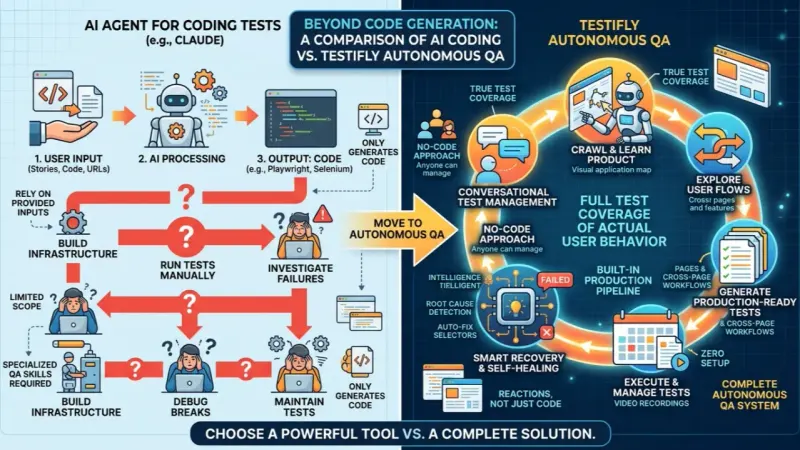
The primary limitation of using general-purpose AI agents for testing is their dependency on existing context. Claude generates Playwright or Selenium scripts based on your user stories, URLs, or codebase, so it essentially guesses optimal test paths. If your code contains hidden bugs or your user stories have gaps, the AI will likely replicate those flaws in the generated tests. This creates a short-sighted view of the problem, leading the agent to generate easy-to-pass tests to meet coverage requirements without verifying the underlying business logic.
Testifly fundamentally shifts this paradigm by learning your product directly rather than relying on manual inputs. Instead of waiting for a prompt, it recursively crawls your entire application, interacting with UI elements via clicks, hovers, and keyboard events, just like a human user. This exploration allows the system to build a complete semantic map of your application’s flows across multiple pages. Only after achieving this deep understanding does it generate page-level tests and cross-page workflows, ensuring that coverage is based on actual user behavior rather than static assumptions.
2. Execution and Test Management
Another significant hurdle with AI-driven testing is the hidden maintenance tax. Claude generates the code and then stops, leaving the engineer to handle the heavy lifting of infrastructure setup, environment configuration, and test organization. Developers often find that while AI speeds up initial scaffolding, the time saved is quickly offset by the time spent managing CI/CD pipelines and manual execution. Without a dedicated platform, you inherit technical debt in the form of thousands of lines of code you did not write but are now responsible for maintaining.
Testifly functions as a full-scale execution platform that eliminates this overhead. It automatically organizes tests into logical features and suites, providing a production-ready pipeline that integrates seamlessly into your CI/CD workflow. Users can control execution cadence and view detailed reports, complete with video recordings of every run, making failures immediately visible. This zero-setup approach enables teams to move from test generation to production-grade monitoring without the burden of building and hosting their own testing infrastructure.
3. Smart Recovery and Self-Healing Tests
One of the most challenging parts of the testing lifecycle is investigating flaky or failing tests. With AI-generated scripts, a failure leaves the developer to determine if the cause was a selector change, a network timeout, or a genuine product bug. Many AI agents rely on brittle CSS selectors or hard-coded waitForTimeout calls, which frequently lead to race conditions and intermittent failures in CI environments. Troubleshooting these fragile tests can eventually consume up to 60% of a QA team’s total effort.
Testifly solves this by implementing smart recovery and autonomous self-healing. When a test fails, the system investigates the root cause, detecting whether it is a UI shift, a logic change, or a regression, and automatically fixes broken selectors where possible. Rather than presenting a stack trace, it provides clear explanations and may simply ask, “Did this feature change?” Based on your input, Testifly realigns the test suite to the new behavior or flags the issue as a bug, eliminating the need for manual log investigation.
Furthermore, Testifly introduces conversational test management to bridge the gap between technical requirements and user intent. Instead of forcing engineers to navigate complex test repositories or IDEs, the platform provides a chat-based interface that lets you query existing tests, generate new scenarios, or visualize current coverage. This approach turns quality management into a continuous dialogue, allowing stakeholders to understand the product’s health without ever opening a terminal or looking at a line of Playwright code.
4. No-Code Approach
The accessibility of this no-code approach cannot be overstated. Effective use of general AI agents like Claude often requires considerable prompt engineering, specialized QA expertise, and deep knowledge of automation frameworks. This creates a bottleneck where only developers or technical QA specialists can own the quality process. Testifly removes these barriers, enabling anyone on the team, from product managers to business analysts, to verify features and maintain the test suite without specialized coding or AI skills.
In summary, the choice between Claude and Testifly is the choice between a tool and a system. Claude is a powerful pair programmer for generating snippets, but it lacks the product context and execution environment to provide true peace of mind. Testifly represents a complete autonomous QA ecosystem that explores, learns, and heals itself. If your goal is a production-grade testing pipeline that effectively covers all your user journeys while you focus on shipping features, moving from AI-assisted scripting to autonomous system testing is essential.
Amihay Schwarz
Founder, Testifly